
Looking for a home takes time, and it’s easy to miss something when a place you like comes up. Here’s a short checklist for renting and buying in England, and how Keymews property search can help. It’s free, and you don’t need an account.
Before you search: know your budget
Renting. Landlords and referencing companies usually look for a yearly household income of about 30 times the monthly rent. On £36,000 a year, that’s rent of up to about £1,200 a month. If your income is lower, a guarantor can often make up the difference.
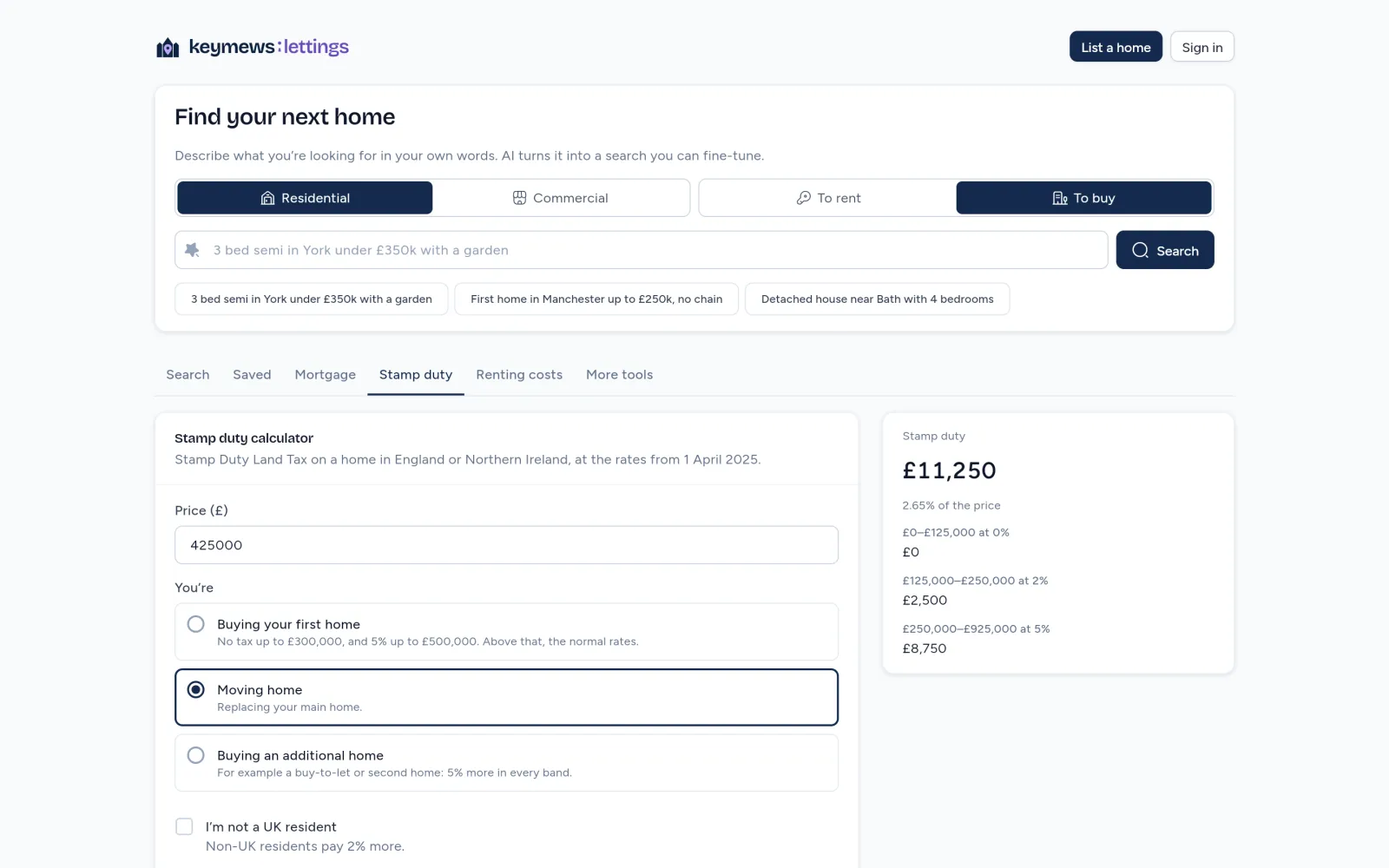
Buying. Lenders typically lend around 4 to 4.5 times your household income, and the deposit makes up the rest. Remember stamp duty: first-time buyers pay none up to £300,000, then 5% up to £500,000.
The Mortgage, Stamp duty and Renting costs calculators in Keymews property search do these sums for you, at the current rates. Under More tools there are also Buying costs (the cash you need on top of the deposit), Rent or buy and Rental yield.
Renting: what to check
- The rent is the advertised rent. Under the Renters’ Rights Act, landlords and agents can’t ask for or accept offers above the advertised rent, so there’s no bidding war.
- Deposits have limits. A holding deposit to reserve a home is at most one week’s rent. The tenancy deposit is at most five weeks’ rent (six if the yearly rent is £50,000 or more), and it must be protected in a government-approved scheme within 30 days.
- You can’t be turned away for receiving benefits or having children. Adverts that say “No DSS” or “No children” aren’t allowed.
- Expect a Right to Rent check. Landlords in England must check that you can rent in the UK, usually with a share code or your documents.
- Ask the questions that matter to you: bills, parking, pets, the length of the commute, and what the energy rating (EPC) says about heating costs.
- Read the government’s guide. How to rent explains your rights and what your landlord must give you.
The rules are changing in stages; check GOV.UK for what applies now.
Buying: what to check
- Get a mortgage agreement in principle before you view, so you know what you can borrow.
- Budget for more than the deposit: stamp duty, a survey, conveyancing and moving costs.
- Ask about the chain, the tenure (freehold or leasehold), and any service charge or ground rent.
Buying or selling your home on GOV.UK covers each step.
Searching with Keymews
At lettings.keymews.co.uk, choose To rent or To buy and describe what you want in your own words, such as “2 bed flat in Leeds under £1,200 with parking”. AI turns it into a search you can fine-tune by area, budget, bedrooms and type. You can also search near where you are; your location is rounded to about 100 metres.
Tap the heart to save a home; saving needs a free account, and searching doesn’t. Each home links to its listing page, where you can ask the landlord a question, book a viewing yourself or apply.
The homes are listed by landlords who use Keymews. If you’re a landlord, you can advertise a home to rent or for sale on the Premium plan.
This article is general information, not legal or financial advice.